Showing posts with label ubuntu. Show all posts

Goodbye XGL, Goodbye AIGLX (Hello Xorg 7.1?)

Something awesome happened today.
NVIDIA released a beta of their new 1.0-9625 drivers. I'll just skip to the good part, as NVIDIA's James Jones explained it:

Neither Xgl or AIGLX are required to use compiz with the NVIDIA drivers now that they natively support GLX_EXT_texture_from_pixmap.

Xgl is an X server that renders using OpenGL and runs on top of another X server. It was the first X server available to support GLX_EXT_texture_from_pixmap.

AIGLX stands for Accelerated Indirect GLX. It is not related to compiz or GLX_EXT_texture_from_pixmap at all, except that support for GLX_EXT_texture_from_pixmap in the open source DRI OpenGL drivers required it. NVIDIA has always supported Accelerated Indirect GLX rendering.

NVIDIA supports both Direct AND Indirect rendering with the GLX_EXT_texture_from_pixmap extension. Users should not need to install any additional software to run compiz with new NVIDIA drivers. Please see the just-created sticky thread covering the basic setup steps.

That's right. These drivers feature hardware support for the mystical "GLX_EXT_texture_from_pixmap" extension, which now allows your videocard to accelerate your wobbly windows, among other things.

The catch? They require Xorg 7.1 or later. That means Ubuntu 6.06/Dapper Drake users are out of luck, unless they feel like compiling X from source (not such a good idea.) The good news is that Ubuntu 6.10/Edgy Eft features Xorg 7.1, so NVIDIA users will be able to benefit from this when Edgy is released (or if they're running Edgy already).

If you're using Xorg 7.1 and want to give it a shot, here's the sticky with instructions. (Also, this feedback thread might come in handy.)

Your move, ATI.

Update: A reader has pointed our that AIGLX has been merged into Xorg 7.1, and it's now enabled by default. So while it's not quite "goodbye" forever to AIGLX, you don't actually have to do anything manually to get it (and you shouldn't have to worry about it).

Banshee 0.11 Released!


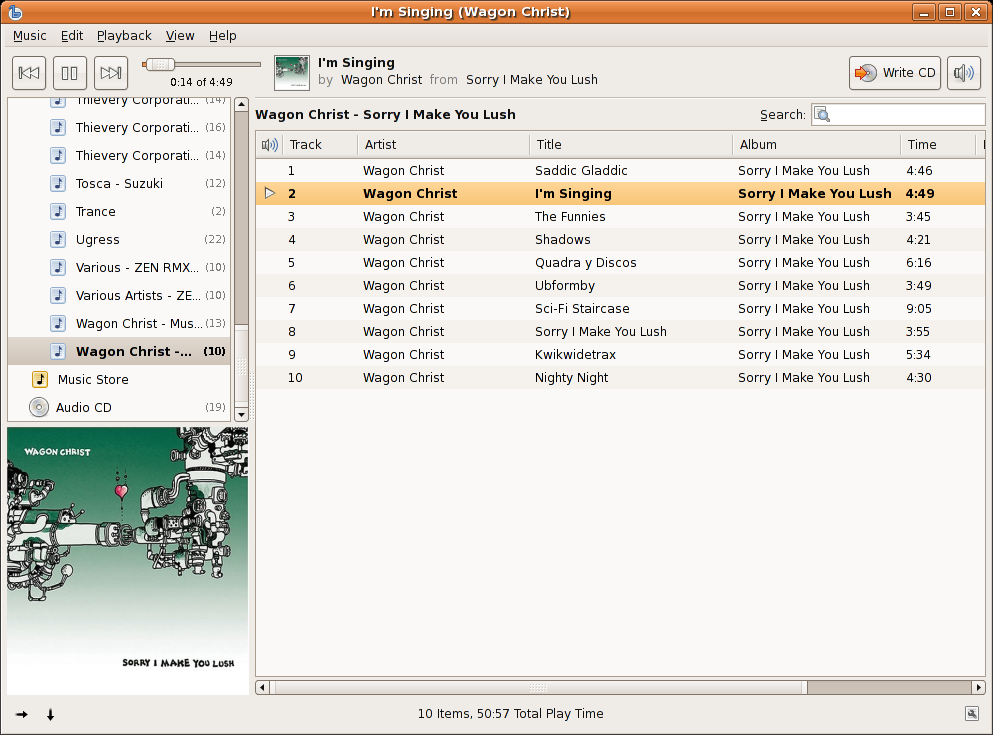
It's been a while since the last Banshee release, but the wait was well worth it. Among the new features in Banshee 0.11 are better tagging support (including writing for all the readable formats), the ability to import a selection or all the music from a digital audio player into Banshee, one-click track rating, an improved preferences dialog, and a new song-change notification bubble (using libnotify, so they should have a somewhat consistent look with the rest of the desktop).

A song-change notification


There's also three new official plugins:
  • Recommendations - This uses the awesome Last.fm service to recommend you different artists based on what you're listening to. The plugin also tells you some interesting stats about the artist you're currently listening to.

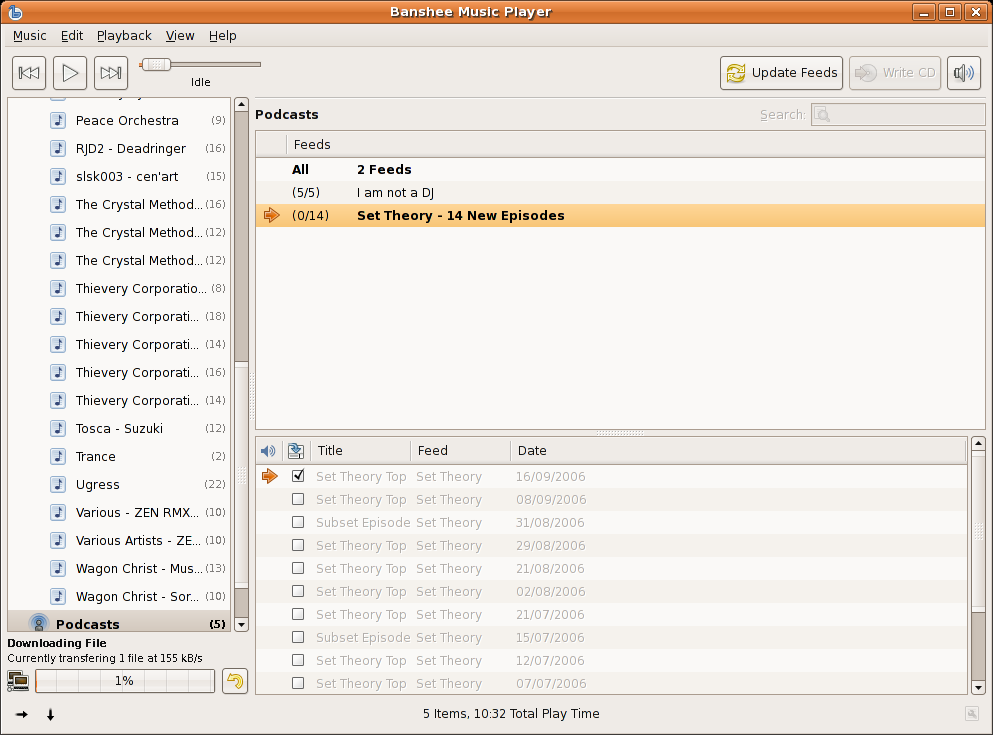
  • Podcast - Banshee now handles podcasts in all their glory. The interface is very smoothly integrated into Banshee and is easy to use. As of the beta, I noticed that you couldn't drag-and-drop a podcast onto a digital audio player, but I haven't tested it yet in the final release.


  • Downloading a podcast while playing music


  • Mini-mode - Sick of Banshee taking up a sizable chunk of screen space? This new plugin allows you to flip Banshee into "mini-mode", which provides a compact player interface instead of the usual library view. The mini-mode interface is really well designed, check it out!

The new mini-mode view


As I said before in my Banshee 0.11 preview, this is the Banshee release I think everyone's been waiting for. Banshee is now a fully featured music playback and management application, and has quickly become a shining star in the world of open source software. It's fast development, great polish, and intuitive interface make it a great example of open source done right. Is it perfect? Well, it's still a little sluggish, but I think it's well worth the trade-off for the excellent feature-set.

Update: I've posted a some instructions on how to install Banshee 0.11 in Ubuntu 6.06. Enjoy! :)

Why I love GNOME (part 1?)

If someone asked me, "What's the most underrated feature in GNOME?", I'd undoubtedly show them this:


Did you see that?

All I had to do to extract that archive was right-click on it, and hit "Extract here". That's it. I didn't have to open an application and choose where I wanted to extract the archive to or anything. (It's probably the feature I miss the most when I use Windows or OS X...)

Oh yeah, and I forgot the coolest part: If the archive you're extracting contains a bunch of files that aren't grouped in a parent folder, it knows to create a new directory to throw them in (so you won't end up with files littered all over your desktop.) Neato.

What do you think is the most underrated feature in Linux, GNOME, or whatever desktop environment you use?

Ubuntu Deja Vu...

Get GNU/Linux and Linux.org

There's an interesting post on Digg that hasn't quite made the front page yet:

Is Linux.org hurting Linux?


If you've ever visited Linux.org, you'll probably have an opinion on this.
My opinion?
Absolutely.

The majority of the people who've taken the poll on the Ubuntu Forums seem to agree.

Is there something better?
Absolutely.

It's clean, simple, eye-catching, and the information that the community wants to send to potential users is easy to get to. While Get GNU/Linux does have some typos and some GNU-isms (I think the general public might not get the free beer/free speech thing), it's certainly a great start. I think the official Ubuntu site in particular does the best job I've seen at explaining Linux and the concept of open development:

Ubuntu is a complete Linux-based operating system, freely available with both community and professional support. It is developed by a large community and we invite you to participate too!

The Ubuntu community is built on the ideas enshrined in the Ubuntu Philosophy: that software should be available free of charge, that software tools should be usable by people in their local language and despite any disabilities, and that people should have the freedom to customise and alter their software in whatever way they see fit.

This makes more sense to me than Get GNU/Linux's:

Gnu/Linux, or simply Linux, is an alternative to Microsoft Windows�. It is easy to use and gives more freedom to users. Anyone can install it: Linux is free as beer and as speech.

The last thing I'd like to throw into the mix here is that the GNU label is just plain ugly. The general public doesn't need to know what GNU is (nor will they care). Like I mentioned in the comments of the Digg article, there's a reason it's just "OS X" and not "GNU/OS X" [I stand corrected... While OS X does ship with some GNU utilities, it's apparently not warranted to call it "GNU/OS X" since it isn't 'free'. The Wikipedia article on GNU seems to agree with me at one point though: That GNU/Linux meant GNU utils + Linux kernel... (hence GNU/OS X, by my initial logic)]


(And if I may be so bold, look at the Ubuntu site again. How many times is the distribution referred to as "Ubuntu" rather than "Ubuntu Linux"? Simply put, anyone who doesn't know that Ubuntu is Linux won't care that is, and anyone who does care already knows.)

Linux Distros Timeline

I spotted a cool timeline over on Digg that shows when each major Linux distribution was created and was branched.
It's neat to see how recent Ubuntu really is relative to all the other distros, and to see how many forks/branches there are.

I think MythTV is trying to tell me something....

I think my MythTV box is trying to tell me something:

What kernel would Jesus compile?

Does the bluescreen of death make you spew forth fire and brimstone, or are you the type that just says a quiet prayer? Now, God can be on your desktop, with Ubuntu: Christian Edition.

Read on at APC Magazine...
(It's funny)

Upstart - Goodbye Init

I spotted something delicious over on Planet Ubuntu recently:
upstart is a replacement for the init daemon, the process spawned by the kernel that is responsible for starting, supervising and stopping all other processes on the system.

What's so yummy about this? Well, they've got a damn good project outline, explaining why there's a need to replace the ancient init daemon, how upstart is designed, and how it's different from existing solutions such as Apple's launchd and initng. Lastly, it also explains what the state of the project is and what direction it's headed in. This is almost enough to make sure a project succeeds right there - well, that, along with a good leader and lots of free time.

While Upstart is now in Edgy's Universe repository, it's not actually going to be standard in the next Ubuntu. I'm surprised that a next-gen init system hasn't landed in a mainstream distro as of yet. (After a shallow googling, the only distro I could find with InitNG was the obscure Berry Linux.) Most of these next-gen init systems cut startup times, which would make a noticeable difference to the end user. Unfortunately, most of these new init systems just aren't quite ready for public consumption, but when they are, you can bet we'll finally see Linux boot much faster.