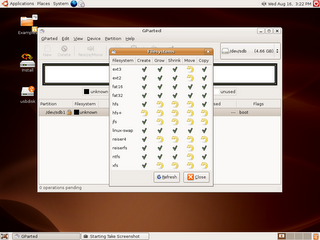
Ubuntu 6.06 Artwork - Doh!

I remember reading somewhere that the artwork in Ubuntu 6.06 didn't quit turn out as good as it should have (due to a lack of time).

Well, after getting my iMac at work to boot off the Ubuntu 6.06 Live/Desktop CD (without Bootcamp, I might add), I was playing around with the Gnome Partition Editor, and I noticed this slight oversight:


Funny :)

(Btw, if anyone's interested: To get my (early 2006 model) iMac to boot off the Ubuntu Desktop CD, I just had to install the latest firmware update for the boot loader. (This page explains it.) After that, I held down the "option" key when I rebooted, and selected to boot off the CD (ironically detected as "Windows"). Linux on a Mac was as easy as that!
(Now, is there any easy way to get a Mac to boot off a USB key with Ubuntu installed?)

Quick Update...

Here's some interesting stuff I've stumbled across in the last week and a half :

  • Linux.com has a new article outlining the new Dates and Contacts apps that are in development. They both use the Evolution Data Server as a backend, meaning they'll use your Evolution contact/calender data. (People have been complaining about Evolution being slow forever, so maybe we'll finally see a lighter frontend coalesce in the next year or two.

  • Ubuntu developers Canonical have hired Jono Bacon as their new Ubuntu Community Manager. Jono is well known throughout the GNOME community, and will serve Canonical very well in this position. (Jono's also heading up the Jokosher project, which has turned into a fantastic multi-track studio.)

  • Christian Schaller has covers some recent developments with Rhythmbox and Totem. (It sounds like the Totem Mozilla plugin might turn into the end-all-be-all media plugin that it should be.) :)

Linux Rock Star Blog

I just stumbled across the "Linux Rock Star" blog, which covers Linux audio applications, hardware, synths, etc.
If you're into audio/music production and run Linux, this site will most definitely come in handy.

There are many music apps available for Linux including Synthesizers, DAW's (Digital Audio Workstations), Trackers, Sequencers and much more. There are also complete Linux Distributions available with all of the programs setup and ready to use. My goal is to cover many of these available programs and make them accessible to the reader.


Sounds like a niche that could use filling! Check it out and be sure to add this one to your feed reader.

Another Fake USB Drive Note

Guess what I just spotted on Geeks.com?

Same packaging, ergo same manufacturer, but different USB key.

Has anyone bought one of these? Can it actually hold ~4 GB of data?

Open Source Graphics Drivers - The Revolution?

Digg scooped up two very important tidbits today:

  • Intel just released open source drivers for their i965 chipset graphics controller.

  • InfoWorld is reporting that AMD is "strongly considering open-sourcing at least a functional subset of ATI�s graphics drivers", following the recent aquisition of ATI by AMD.

What's all the fuss about?
First off, Intel has a good history of releasing open source drivers, and they're continuing to set a great example for other big industry players. (Their new "Intel Linux Graphics" site is a good move.) The press coverage that they're getting for these new drivers comes at a particularly opportune time, considering what AMD/ATI's thinking about doing. I think this'll put some pressure on AMD/ATI to release open source graphics drivers, which is a good thing. (The current legal situation with Linux distributions bundling and using binary-only drivers is a bit sticky.)

NVIDIA's closed-source drivers and support have consistently beat the quality of ATI's offerings, so it would be quite the shocker if ATI open-sourced their drivers. ATI would suddenly have much more respect within the Linux community and their graphics cards would (hopefully) all work "out-of-the-box" in Linux. The decision would essentially leave NVIDIA no choice but to similarly open-source their own drivers.

Now, this is all best case scenario - There's other possibilities here as well. I think the worst that could happen if ATI's drivers do get open-sourced is that, well, we have "at least a functional subset". That could mean just 2D acceleration support, which is better than nothing, but not nearly as good as it could be. In that case, I doubt that NVIDIA would end up releasing any form of open source driver in response - ATI just wouldn't have upped the ante enough.

Regardless, the push for open source graphics will definitely be one to keep an eye on over the next year.

Shuttleworth: Communicating Release Goals

Ubuntu head honcho Mark Shuttleworth has just blogged about communicating release goals. Most of the article is an email from Matt Zimmerman (an Ubuntu team member) which talks about the importance of clearly expressing the team's release goals in order to prevent end-user disappointment.

Matt Zimmerman writes:
Many are criticizing shortcomings in Ubuntu which have existed for years now, or deplore the lack of eye candy and other superficial features, as justification for an overall negative impression of the release. In particular, I see repeated mentions of:

- Lack of 3D support out of the box on nVidia chipsets: [0]

- Need to use the command line for certain administrative tasks (including the above) [0] [5]

- Lack of out-of-the-box support for Java, Flash, MP3, DVD, etc. (RestrictedFormats) [0] [4]

- Lack of 3D accelerated desktop effects and other eye candy (e.g. Xgl/AIGLX, prettier usplash) [1] [5]

- Lack of support for a particular hardware component (e.g., wireless card or printer) [1] [2] [4] [6]

- Ubuntu not being easy enough for the typical user [0]

- Lack of availability of development tools in the default install [0] [2]

- Manual partitioning is clunky [0] [3]

None of these are new problems, but they are pointed out as examples of major shortcomings by these reviews. It's notable that in some cases, we're being compared with Windows, rather than other Linux distributions, which is a much higher bar, but overall my impression is that there has been a disconnect between the expectations of the community and what we delivered with Dapper. In particular, I see indications that users expected Dapper:

- to be better-looking ("polished")
- to have more long-standing feature wishes implemented ("polished")
- to have no regressions from Breezy ("polished")
- to have fewer bugs than a typical Ubuntu release ("polished")

(important part bolded for emphasis)

Now, is there anything surprising about the fact that Ubuntu users want "more long-standing feature wishes implemented"?

When I first started using Ubuntu, I was extremely pleased by the number of things that it "got right". Applications that it shipped with it worked out of the box (I had terrible experiences with older versions of Mandrake), and it's hardware support was among the best of the Linux distributions.

Now, it seems that Ubuntu's pace of continuing to "do things right" has slowed down. The reason why people keeping commenting about Flash/MP3/Multimedia/Nvidia/ATI/etc. support being major negative points is because:
A) Simply put, they are major flaws. (I don't think anyone would deny this.)
B) They haven't been fixed in any Ubuntu release to date.

The community's expectation is for the Ubuntu team to take these problems seriously and to address them (that means fix them). These were major problems two years ago, and they're still major problems now. If the Ubuntu team doesn't move to fix these problems soon, it's going to start wearing down the morale of the community. (Nobody likes developers who ignore the complaints of their end-users.)

So, what have we learned? Perhaps that even if we meet our goals in our own eyes, we may be considered a failure by some if they have a different interpretation of our intentions.


I'm going to agree with Matt on this one, as it's a very important lesson for any developers who have a fair amount of contact with their users. Game developers often make the classic mistake of mentioning planned features that never end up seeing the light of day, which only leaves gamers disappointed.

Lastly,
...of the five specific examples, it's quite likely that no more than one or two will actually be implemented in Edgy.


If Edgy fails to include at least some of the "next-generation" features originally mentioned by Mark Shuttleworth and fails to fix some of the major missing pieces that the community keeps complaining about (Flash, multimedia support, etc.), then there's going to be an excellent opportunity for a new Linux distribution to come along and dethrone Ubuntu.

C'est la vie.